

Discounted cash flow valuation (DCF) calculates an asset's present value by converting forecast future cash flows into today's money using a discount rate. In its simplest form: PV = Σ CFt / (1 + r)^t, where each period's cash flow is divided by a compounding discount factor. The method is forward-looking and grounded in financial fundamentals, which makes it well suited to investment analysis and property valuation. The main caveat, as Investopedia notes, is that DCF outputs are highly sensitive to estimates of future cash flows and the chosen discount rate, so small assumption changes can produce large swings in value.
Key takeaways
Discounted cash flow valuation produces a defensible asset value only when cash flows, discount rates, and terminal assumptions are matched correctly and stress-tested against market evidence.
| Point | Details |
|---|---|
| Match cash flows to discount rate | Use FCFF with WACC for asset value; use FCFE with cost of equity for equity value. Never mix the two. |
| Terminal value dominates | When terminal value exceeds 65% of gross asset value, stress-test the exit cap rate or terminal growth rate aggressively. |
| Document every assumption | Record the source and date for each input; a model without an audit trail will not withstand professional or legal review. |
| Use DCF for non-flat income | DCF earns its place when income is variable; for stabilised assets, income capitalisation is often faster and equally robust. |
| Cross-check with market evidence | Always reconcile DCF outputs against comparable sales and market cap rates; a result that diverges materially needs a documented explanation. |
Table of Contents
- What is discounted cash flow valuation and how does the formula work?
- Why use a DCF and when is it the right tool?
- Which cash flows should you model?
- How do you determine the right discount rate?
- How do you forecast future cash flows and choose a horizon?
- What are the two terminal value methods and which should you use?
- How do you discount the forecast and arrive at a final value?
- How do you run sensitivity analysis and what mistakes should you avoid?
- Worked DCF example: Australian commercial property
- How do licensed valuers apply DCF in Australian practice?
- A practitioner's perspective on what DCF models hide
- When to commission a certified DCF valuation from Valuemax
- Sources
What is discounted cash flow valuation and how does the formula work?
The core principle is straightforward: a dollar received in the future is worth less than a dollar today, because today's dollar can be invested and earn a return. DCF converts each future cash flow back to its present value using a discount rate that reflects the riskiness of those flows, then sums those present values to arrive at the asset's intrinsic worth.
The DCF present value formula: PV = CF₁/(1+r)¹ + CF₂/(1+r)² + … + CFₙ/(1+r)ⁿ + TV/(1+r)ⁿ
Where CF = cash flow in each period, r = discount rate, n = number of forecast periods, and TV = terminal value at the end of the forecast horizon.
Harvard Business School Online describes the practical steps as: forecast free cash flows, estimate a discount rate (WACC or cost of equity), calculate terminal value, and discount everything back to the present to get intrinsic equity or enterprise value.
A few terms appear throughout any DCF model and are worth defining clearly:
FCFE (Free Cash Flow to Equity): the cash available to equity holders after operating costs, capital expenditure, working capital changes, and debt repayments. Use FCFE with the cost of equity as the discount rate.
FCFF (Free Cash Flow to the Firm): also called unlevered free cash flow, this is the cash generated by the business before financing costs. Use FCFF with WACC as the discount rate to get enterprise value.
WACC (Weighted Average Cost of Capital): a blended discount rate that weights the cost of equity and the after-tax cost of debt by their proportions in the capital structure.
Terminal value (TV): the estimated value of all cash flows beyond the explicit forecast period, typically calculated using a perpetuity growth formula or an exit multiple. Terminal value often represents the majority of total DCF value, which is why its assumptions deserve close scrutiny.
Why use a DCF and when is it the right tool?
DCF is a forward-looking method that ties value directly to the income a property or business is expected to generate. That connection to fundamentals is its greatest strength. RICS guidance confirms that DCF is one of several valid valuation methods in professional practice, and that professional judgement and cross-checks against market methods remain essential.
Strengths of DCF:
- Links value explicitly to the asset's income-generating capacity, not just current market sentiment
- Separates operating assumptions from financing decisions, which aids transparency
- Handles variable income profiles, lease expiries, rent-free periods, and phased development that simple capitalisation cannot model cleanly
- Produces a range of values when paired with sensitivity analysis, supporting better investment decisions
Limitations to keep in mind:
- Highly sensitive to the discount rate and terminal value assumptions; small changes compound over a long horizon
- Requires detailed, defensible cash flow forecasts that can be difficult to source for thinly traded assets
- Terminal value often dominates total value, creating a risk that the model's conclusion rests on a single assumption
- Can give a false sense of precision when inputs are speculative
For stabilised assets with flat, predictable income, simple income capitalisation is often faster and equally robust. DCF earns its place when income is non-flat: leases with upcoming breaks or expiries, assets under refurbishment, or properties with phased development. That distinction, drawn clearly in interval-soft's DCF property guide, is the most practical rule of thumb for choosing between methods.
Which cash flows should you model?
The choice of cash flow definition is not a technicality. It dictates the correct discount rate and the type of output the model produces. Mixing definitions is one of the most common and damaging errors in DCF practice.
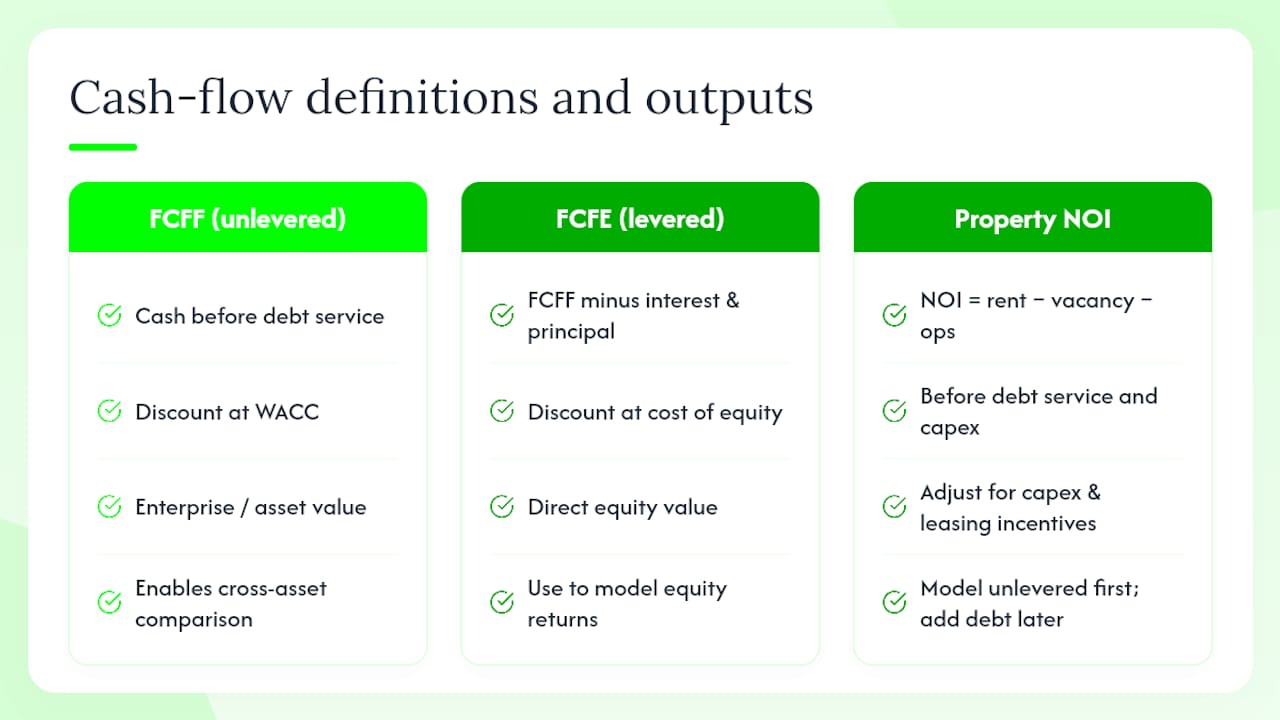
FCFF (unlevered): models the cash the asset generates before any debt service. Discount at WACC to get enterprise value or asset value. This is the standard starting point for commercial property DCF and corporate valuations because it allows comparison across assets with different capital structures.
FCFE (levered): starts from FCFF and deducts interest and principal repayments, leaving the cash available to equity. Discount at the cost of equity to get equity value directly. Useful when the financing structure is fixed and the investor wants to model returns on their equity stake.
Property NOI and net cash flow: in property DCF, the cash flow construct is typically net operating income (NOI), which is gross rental income less vacancy allowance and operating expenses, before debt service and capital expenditure. Adjustments for capex, leasing incentives, and timing of lease renewals are then applied to arrive at net cash flow. Wall Street Prep's DCF training describes the unlevered approach as the standard: forecast unlevered free cash flows, discount at WACC to get enterprise value, then subtract net debt to get equity value.
Pro Tip: For property transactions, model unlevered cash flows first. This gives you a clean asset-level value that is comparable across deals regardless of how each is financed. Layer in the specific debt terms afterwards to calculate equity-level returns for your particular capital structure.
How do you determine the right discount rate?
The discount rate is where DCF quantifies risk. Damodaran's valuation framework is explicit: riskier cash flows require a higher discount rate, and that rate must be grounded in defensible market evidence rather than ad hoc judgement.
CAPM for the cost of equity
The Capital Asset Pricing Model (CAPM) is the standard method for estimating the cost of equity:
Cost of Equity = Rf + β × (Rm − Rf)
Where:
- Rf = risk-free rate (typically the yield on Australian Government Securities, sourced from the Reserve Bank of Australia)
- β (beta) = a measure of the asset's sensitivity to market movements; listed property companies or REITs provide a reference point for property-specific betas
- (Rm − Rf) = equity risk premium (ERP), the additional return investors require over the risk-free rate for holding equities
WACC for firm or asset-level valuation
WACC = (E/V) × Ke + (D/V) × Kd × (1 − t)
Where:
- E/V = equity as a proportion of total capital
- D/V = debt as a proportion of total capital
- Ke = cost of equity (from CAPM)
- Kd = cost of debt (the interest rate on borrowings)
- t = corporate tax rate (currently 30% for most Australian companies, 25% for base-rate entities)
Practical inputs for Australian valuations:
- Risk-free rate: use the yield on 10-year Australian Government bonds, published by the RBA. The May 2025 RBA rate movement and subsequent market repricing have shifted benchmark yields, so always use a current quote rather than a historical average.
- Beta: for unlisted property assets, use the average beta of listed Australian REITs in the relevant sector (retail, office, industrial) as a starting point, then adjust for leverage differences.
- ERP: academic and practitioner sources for Australia typically place the ERP in the range of 5–7%, though this varies with market conditions. Damodaran's publicly available country risk premium data is a widely used reference.
Pro Tip: Document every rate choice with a source and date. Run a sensitivity test across a 1–2 percentage point range around your central discount rate. If the investment decision flips within that range, the deal is marginal and the model should say so explicitly.
How do you forecast future cash flows and choose a horizon?
Reliable cash flow forecasting starts with the operating drivers, not the spreadsheet. For a property DCF, the key inputs to project are:
- Gross market rent and contracted rent for each tenancy
- Vacancy allowance and lease-up timing after expiries
- Outgoings recovery rates and any gross-lease adjustments
- Operating expenses (management fees, insurance, rates, maintenance)
- Capital expenditure for planned refurbishment or building works
- Leasing incentives (rent-free periods, fitout contributions) and their timing
A forecast horizon of several years is standard in Australian commercial property practice. Shorter horizons work when the income profile stabilises quickly; longer horizons are justified for development assets or properties with long-dated leases where the income story plays out over a decade or more. Extending the horizon beyond 10 years rarely adds precision because the discount factor reduces those distant cash flows to near-zero present values.
One-off items such as a major refurbishment or a lease expiry cluster deserve explicit modelling rather than being smoothed into an average growth rate. Phased development projects should model each stage separately, with realistic construction timelines and pre-commitment assumptions drawn from comparable projects in the same submarket.
Always reconcile your forward projections against the asset's audited historical financials and current market comparables. If your modelled rent growth diverges materially from what comparable leases in the same precinct are achieving, the model needs a documented justification or a revised assumption. The key factors affecting property valuation in Melbourne and Sydney provide useful local benchmarks for rent growth and vacancy assumptions.
Pro Tip: Build a separate assumptions register outside the main cash flow columns. List each driver, its source, and the date it was confirmed. This makes the model auditable and makes sensitivity testing faster because you can change one cell and see the impact immediately.
What are the two terminal value methods and which should you use?
Terminal value captures everything beyond the explicit forecast period. Because it is discounted back over the full horizon, it frequently represents more than half of total DCF value. Getting the terminal assumption right matters more than getting any single forecast year right.
Gordon growth model (perpetuity growth)
TV = CFₙ × (1 + g) / (r − g)
Where g is the long-run sustainable growth rate and r is the discount rate. The constraint is non-negotiable: g must be less than r. A terminal growth rate above the discount rate implies the asset grows faster than the economy forever, which is not a credible assumption. For Australian commercial property, a terminal growth rate of 2–3% is broadly consistent with long-run inflation expectations, though the appropriate figure depends on the asset class and location.
Exit capitalisation rate method
TV = NOIₙ₊₁ / Exit Cap Rate
This approach divides the stabilised NOI in the year after the forecast period by a market-derived capitalisation rate. It is the more common terminal value method in Australian property DCF because it directly references observable market evidence. The exit cap rate should reflect the expected market conditions at the end of the forecast period, typically set slightly above the entry cap rate to account for building age and lease profile deterioration.
Choosing between the two:
- Use the Gordon growth model for corporate or business valuations where a perpetuity assumption is conceptually appropriate
- Use the exit cap rate for property valuations because it anchors terminal value to market evidence
- Always cross-check both methods; a large divergence signals that one set of assumptions is internally inconsistent
Pro Tip: Run your terminal value calculation using both methods and present both results. If they differ by more than 10–15%, revisit the underlying assumptions before presenting the valuation. Practitioners and reviewers will ask the same question.
Model Reef's real estate DCF guide recommends keeping scenarios and sensitivities visible to reviewers at all times, precisely because terminal value assumptions are where most valuation disputes originate.
How do you discount the forecast and arrive at a final value?
With cash flows projected and a discount rate established, the calculation sequence is straightforward:
- Discount each forecast year's net cash flow by dividing it by (1 + r)^t, where t is the year number. Year 1 cash flow is divided by (1 + r)¹, Year 2 by (1 + r)², and so on.
- Discount the terminal value using the same factor as the final forecast year: TV / (1 + r)ⁿ.
- Sum all discounted cash flows and the discounted terminal value to get the gross asset value (enterprise value or property value).
- Add non-operating assets such as surplus land or cash held outside the operating entity.
- Subtract debt and non-equity claims: outstanding loan balances, deferred tax liabilities, and any minority interests.
- The result is equity value. For a per-share metric, divide by the number of shares or units on issue.
For property valuations, two additional adjustments are common:
- Deduct estimated transaction costs (stamp duty, legal fees, agent commissions) if the output is intended to represent the net realisable value to a vendor, rather than the gross asset value a purchaser would pay.
- Adjust for GST where applicable, particularly for commercial properties where the going-concern exemption may or may not apply depending on the transaction structure.
How do you run sensitivity analysis and what mistakes should you avoid?
A single-point DCF output is not a valuation. It is a starting point. Sensitivity analysis converts that single number into a range that reflects the genuine uncertainty in the inputs.
The two variables that move property DCF values most are the discount rate and the terminal cap rate (or terminal growth rate). A simple two-way sensitivity table presents the asset value at combinations of these two inputs, giving the reader an immediate picture of how much the conclusion depends on each assumption.
Illustrative values only. Figures will vary with the specific cash flow profile modelled.
Common DCF mistakes to avoid:
- Mismatching cash flows and discount rates: discounting FCFE at WACC, or FCFF at the cost of equity, produces a systematically wrong answer
- Over-reliance on terminal value: if terminal value exceeds 70–80% of total DCF value, the explicit forecast period is doing little work and the model is essentially a capitalisation in disguise
- Hardcoding assumptions with no audit trail: a model where inputs are buried in formula cells and cannot be traced to a source is indefensible in a professional context
- Mixing nominal and real inputs: nominal cash flows must be discounted at a nominal rate; real cash flows at a real rate. Mixing the two inflates or deflates value
- Over-optimistic rent growth or vacancy recovery: property DCFs frequently fail peer review because rent growth assumptions exceed what comparable market evidence supports
Pro Tip: Present three scenarios: base, upside, and downside. The base case uses your best estimate of each input. The upside and downside cases stress the two or three assumptions that drive the most value. Showing the range is not a sign of uncertainty; it is a sign of rigour.
Worked DCF example: Australian commercial property
The following example models a small commercial office building in Melbourne with a five-year forecast horizon. All figures are illustrative and are intended to demonstrate the calculation method.
Assumptions: Purchase price $15m, initial NOI $900,000, annual NOI growth 2.5%, capex Year 3 $400,000, discount rate 7.0%, exit cap rate 5.75%, net debt at valuation date $8m.
Step-by-step calculation:
- Sum PV of forecast cash flows: $841,121 + $805,967 + $445,337 + $739,567 + $708,317 = $3,540,309
- Calculate terminal value (exit cap method): Year 6 NOI = $993,432 × 1.025 = $1,018,268. TV = $1,018,268 / 0.0575 = $17,709,009
- Discount terminal value: $17,709,009 / (1.07)⁵ = $17,709,009 × 0.7130 = $12,626,523
- Gross asset value: $3,540,309 + $12,626,523 = $16,166,832
- Subtract net debt: $16,166,832 − $8,000,000 = Equity value: $8,166,832
The discount rate input was derived from the 10-year Australian Government bond yield published by the RBA, with added property risk premium and asset-specific adjustments based on the building's characteristics. The exit cap rate reflects market evidence from comparable Melbourne office transactions., consistent with the local market factors currently influencing Sydney and Melbourne commercial yields.
Sensitivity check:
Gross asset values, illustrative. The base case ($16.2m at 7.0% / 5.75%) sits near the middle of the range, which is a healthy sign that the model is not perched at an extreme.
How do licensed valuers apply DCF in Australian practice?
In Australian property valuation, DCF is the preferred method when income is variable or non-stabilised. RICS standards confirm that DCF is one acceptable method among several, and that professional judgement and cross-checks against market methods are non-negotiable. For stabilised assets with flat, long-term leases, income capitalisation is often the primary method and DCF serves as a cross-check.
When valuers choose DCF in Australia:
- Properties with lease expiries, break options, or rent reviews within the forecast period
- Assets undergoing refurbishment or repositioning where income is temporarily suppressed
- Phased development projects where cash flows build progressively over time
- Valuations for litigation, expert witness work, or complex tax purposes where a detailed income model is required to withstand scrutiny
Professional documentation standards (RICS/IVS-aligned):
- Every assumption must be documented with its source: market rent from comparable lease evidence, discount rate from a traceable market-derived calculation, growth rates from published forecasts or market surveys
- Sensitivity tables must accompany the base case to demonstrate that the conclusion is robust across a reasonable range of inputs
- The valuation report must state the method chosen, why it was chosen, and how the output compares to any market cross-check
For tax-driven valuations, including capital gains tax and stamp duty assessments, a certified report prepared by a registered valuer is required. The ATO and Revenue NSW both expect valuations to meet professional standards, and a DCF-based report that lacks a documented audit trail will not withstand review. Readers needing a certified valuation for taxation purposes can find guidance on the requirements through Valuemax's tax valuation services.
Pro Tip: When commissioning a valuer for a DCF-based report, ask specifically whether the report will include a sensitivity table and a market cross-check. A report that presents only a single-point value without either is not meeting current professional standards.
A practitioner's perspective on what DCF models hide
The mechanics of DCF are learnable in an afternoon. The judgement required to make a DCF credible takes considerably longer to develop.
Two rules of thumb hold up consistently in practice. First, the terminal value is almost always doing more work than the model's author realises. When terminal value represents more than 65% of gross asset value, the explicit forecast period is providing little more than a warm-up. The real question the model is answering is: what is this asset worth if it stabilises at Year 5 or Year 10 income and trades at the exit cap rate? That is a capitalisation question dressed in DCF clothing. Acknowledging this openly, and stress-testing the exit cap rate aggressively, produces a more honest output than a ten-year cash flow table that obscures the same dependency.
Second, the discount rate is where most valuation disputes begin. Practitioners who choose a rate by feel, or by anchoring to a rate used in a previous deal, are building on sand. Damodaran's principle is worth repeating: the discount rate must quantify risk, and that quantification must be traceable to market evidence. For Australian property, that means a documented build-up from RBA bond yields, sector-specific risk premia, and asset-level adjustments, each with a source and a date. The impact of RBA rate movements on property yields is real and material; a discount rate that has not been updated since the last rate cycle is stale.
On communicating uncertainty: present ranges, not points. A client who receives a single value of $16.2m and later discovers the model produces $14.8m under a modest stress scenario will lose confidence in the analysis. A client who receives a range of $14.8m–$17.9m with a documented base case of $16.2m has been given something genuinely useful. The range is not a sign of weakness. It is the honest answer.
When the income profile is complex, the lease structure is unusual, or the valuation will be used in litigation or tax proceedings, commission a certified valuer. A DCF built in a spreadsheet by an investor is a useful analytical tool. A certified report prepared by a registered valuer, meeting RICS or API standards, is a legally defensible document. The two serve different purposes and should not be confused.
When to commission a certified DCF valuation from Valuemax

For investors and property owners in Melbourne and Sydney who need a DCF-based valuation that will stand up to ATO scrutiny, legal challenge, or transaction due diligence, Valuemax provides certified, independent property valuation reports prepared by registered valuers. Whether the need is a commercial or industrial property valuation for a complex leased asset, or a certified report for capital gains tax or stamp duty purposes, Valuemax's team applies a documented, market-grounded methodology with full sensitivity analysis and market cross-checks included as standard.
Sources
- Discounted Cash Flow (DCF) Explained With Formula and Examples
- Discounted Cash Flow (DCF) Model: Definition, Formula, & Training
- Basics of valuation (Aswath Damodaran - Ch2 / DSV2)
- Discounted cash flow (DCF) valuation — RICS
This article is general information, not a substitute for advice from a qualified financial advisor. Consult a qualified financial professional about your own circumstances before acting on anything here.
Recommended
- Capital Gains Tax (CGT) — News & Insights — ValueMax Property Valuers | Certified Property Valuations in Melbourne & Sydney
- Investment Property Tax — News & Insights — ValueMax Property Valuers | Certified Property Valuations in Melbourne & Sydney
- ATO Compliant Valuation — News & Insights — ValueMax Property Valuers | Certified Property Valuations in Melbourne & Sydney
- Property Investment Advice — News & Insights — ValueMax Property Valuers | Certified Property Valuations in Melbourne & Sydney